
A report on Kensington and Chelsea council’s second public meeting following the publication of the damning Grenfell Tower Phase 2 Report*.
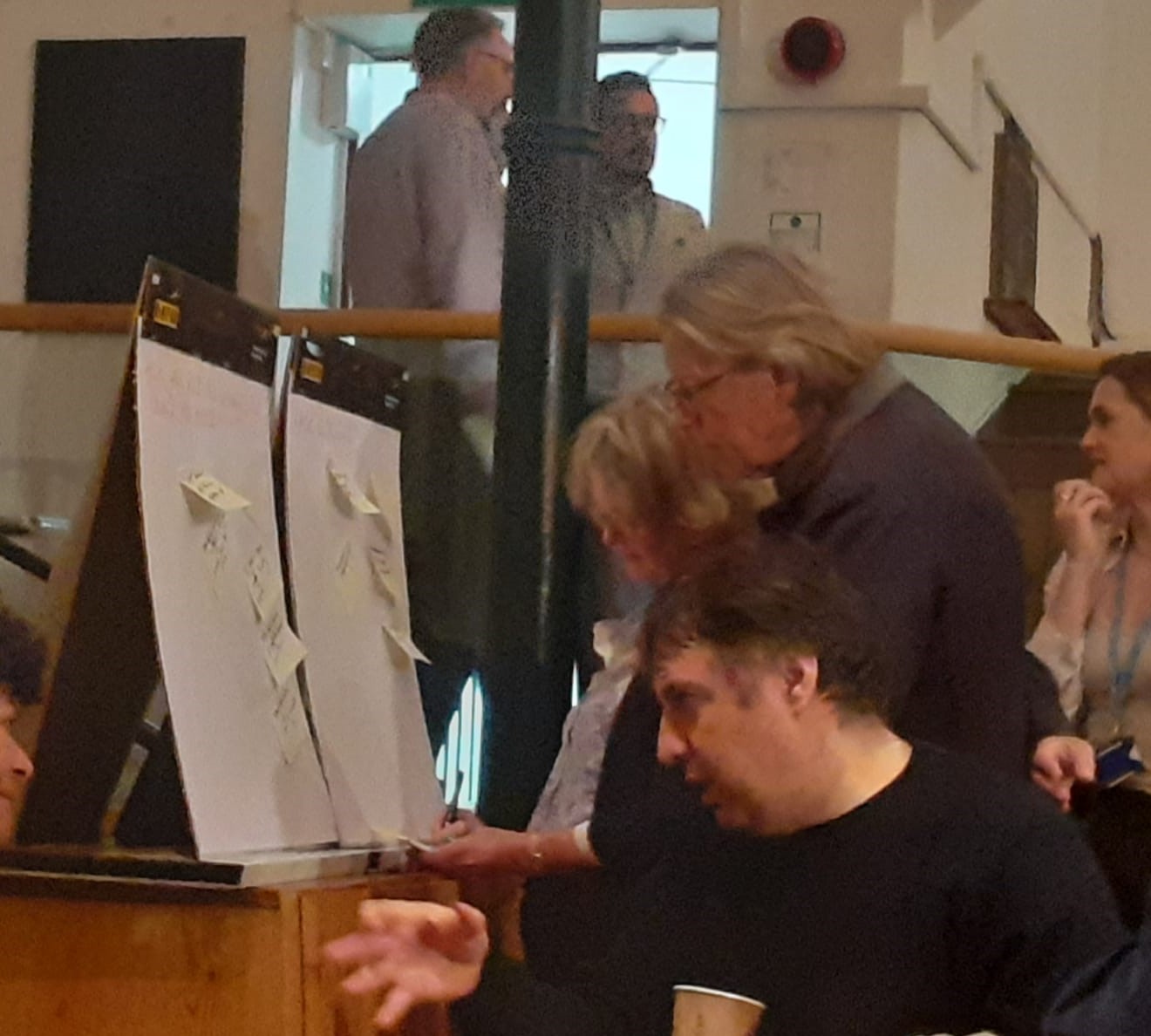
There are so many councillors and officers here, explains RBKC Chief Executive Maxine Holdsworth at the start of the meeting, being held in the Methodist church on the edge of the Lancaster West estate in which the carcass of Grenfell Tower still stands, “because we all need to listen to you”.
The council accepted the findings of the Grenfell Tower Inquiry and RBKC is changing, Holdsworth, and Elizabeth Campbell leader at Kensington and Chelsea since 2017, tell their audience. They’ve printed the changes they say they’ve made on a document placed by a white board and post-it notes by the entrance. RBKC building control staff would from now on be qualified and trained, and there was an emergency planning team at the council. Housing management is, since 2018, back in house. They were monitoring their own contracts, and had new safety standards. And not only that, there is also a culture change in place.
They’d brought in an esteemed clergyman from outside the area, instead of the resident pastor, to facilitate. He opens with a sermon listing states of being: grief, and loss, compassion and mutual respect, alongside some others, and holds 72 seconds silence, a second for each death, before he takes up his role as go between.
And the sham, as one audience member would later describe it, begins. The bishop conducts.
Will it Ever be Fixed?
An elderly resident, his bathtub no good, making him slip and fall and hurt himself when he tries to use it, says that despite him asking again and again nothing has ever been done. Holdsworth answers, saying they’ll deal with it after the meeting. She doesn’t explain why a changed council could have allowed this to persist for so long.
A resident of Lancaster West estate complains (clearly not for the first time) that the external communal doors on the floor of their block haven’t locked for over seven years. Will they ever be fixed? Drug addicts are getting in at night and sleeping in the hallway, property is being stolen, it isn’t safe. She’s lived there for 18 years. “Such disrepair. It’s worse than when the TMO was managing us”. The audience applaud.
Holdsworth says she doesn’t know the detail, but the council officer responsible is there, and he can reply.
“We are aware we’ve had issues with doors, and appreciate we’ve had to carry out a number of repairs that haven’t worked” he says.
“What we have put in place is a programme. And we are going to be upgrading the intercom systems across the estate, starting with those that are in the worst state and then working our way through to the rest of the estate. There should have been some comms that went out to all residents.”
The bishop asks the officer, “Can you say you’ll carry on the conversation beyond this evening?” The officer agrees, and the bishop moves things on.
Patterns, and Repetition
A wheelchair user in temporary accommodation for 12 years needs to kick the door to get out of her flat. Elizabeth Campbell says she’s sorry to hear this. The woman is told that as it’s a housing association property they can’t fix it, but someone will talk to her about it after the meeting.
Someone else describes conditions on Lancaster West. A building site, covered in scaffolding, for over a decade. The housing management now is worse than under the TMO. There’s a lack of transparency. Failure within the local W11 housing management team that the council established on the estate after it folded the discredited TMO.
Elizabeth Campbell speaks slowly, and in a gentle tone. She says she thinks the woman who complained of the state of LWE is right. It’s been difficult for residents, hasn’t it? Just very difficult living on building site, she knows that, and understands, but she hopes that in the end people have better homes. And she was very sorry to hear about it, she said. She concludes, in a soft voice: “What we hear from the Tenants Consultative Committee and from surveys is the biggest problem is my home, and what you’re saying now is that is something we’ve got to look at”.
And the bishop moves on: Would anybody who hadn’t yet spoken like to say something?
A woman on the 20th floor on the neighbouring Silchester estate, the lift doesn’t work. She’s concerned about fire safety. A man speaks of lack of fire breaks and hazards in his flat.
Holdsworth answers the woman on the 20th floor with no lift, it would be picked up after the meeting. To the man with the fire risks, they’d take his details and take it up later.
There’s a distinct and repetitive pattern emerging.
A Challenge, Rejected
An audience member to the council leader: You say you know what it’s like to live in building site – but you don’t know what it’s like to live on Lancaster West Estate. In the spirit of listening and understanding residents, and demonstrating you’re changing, why don’t you volunteer to stay in one of the void properties on the estate to experience what it’s like yourself?
Applause.
Elizabeth Campbell says she accepts she doesn’t know what it’s like to live on the estate, she apologises, profusely, I don’t know what it’s like. I absolutely appreciate that, she says gently, and nodding. Pressed on whether she’ll stay on the estate, she emits a short laugh, replies she has a home, and that they want to get residents to move onto the estate.
(Some of the void flats on LWE have been empty since 2017, families unable to return after the fire and no one moved into the empty homes, but no-one interrupts the order of the meeting to point this out).
A Lancaster West resident: Home should be a place of safety, and solace. Our homes are not a place of refuge, not for many people, whether leaseholders or tenants. In fact over the past dozen or more years my home has been the source of most of my stresses. It’s just fundamentally wrong. And you can never get away from it. I work from home. It’s there all the time. You can never escape it.
He continues: We lack any control, we can’t make decisions that determine how things go, we are totally reliant on your infrastructure. Chasing emails, chasing responses, it takes so much time and energy. My friend has become physically ill, we put it down to the stresses of having to deal with you over his home… That’s the hidden impact of your housing management.
The audience applauds.
Holdsworth answers. A 2018 survey of the condition of the housing stock condition had revealed huge under-investment and properties well below acceptable standards. So while people maybe wanted their homes maintained better and upgraded periodically, she said, instead it felt like it was happening all at once. “I really appreciate you saying what you said tonight, one thing I am going to take away from this is just how stressful it is living with capital works”.
The bishop summarises: “Coming through is the autonomy of the tenant to create their own home, which is being frustrated by how the council relates to the tenant. So let’s go specifically to managing our homes, who would like to speak, who’s not yet spoken?”
Respect for humanity
A woman talks about how she thinks the council systems and staff should treat residents with respect. The bishop repeats: “what you’re asking for is council officers and councillors to respect for your humanity”.
Someone from Trellick Tower points out about the meeting: If one of us voices a particular issue, the way it is being dealt with is you are saying we can talk to you afterward. That’s not an effective solution. There need to be clear paths and procedures, for us as residents, to get efficient outcomes.
Holdsworth replies: The system needs to work. People here tonight have things they feel haven’t been resolved. What we are saying tonight is we’ve heard we haven’t done this the right way, we’ve heard about disabled adaptations that haven’t been done right, we’ve heard about HA tenants whose landlords haven’t done things properly. All I’m saying here tonight is let’s look at some of these problem specifically, you’ve got some of the right people, let’s see if we can make progress.
We deal with 50,000 repairs a year, from 7000 properties, you’re absolutely right – if anything goes wrong: a complex repair, contractor doesn’t turn up or is disrespectful, then we need a way to pick that up…..So we do have a various trades, we’ve got a team that looks at complex cases. Tonight is a good illustration that doesn’t always work.
About the culture change, more than 70% of our staff are new since 2017. We know the standard of social housing landlords is not where it should be, that’s a national issue, so when recruiting we are making sure that staff are trained, we expect them to put residents first, are respectful. I am absolutely committed to continuously improving.
Another resident from LWE: Most people wouldn’t say there’s been a change. Culture change is about leadership. For example, leaseholders on our estate complained after our charges massively increased last year, in response it was adjusted down by £50, but they then asked for an extra £2000. When we asked what it was for they can’t explain, they don’t know what it’s about. That’s what’s wrong with the culture, when you have a simple question they either don’t talk to you, or they stonewall or don’t give you a response. They don’t engage. You’re going round doing exercises where you can say ‘oh we got 30 people in the meeting’, but don’t deliver change. All these pieces of paper about being the best council mean nothing.
Applause.
Someone else: It takes the miracle of God to change people’s hearts. I am asking you to pray to change your hearts so that you feel care. The change has to come from within people’s hearts.
Applause.
Someone, from another west London borough, says there should have been a residents association at Grenfell Tower. RAs should be the voice of residents, they could achieve small things like addressing uneven paving, or big things, he says, like how to design a garden. What is the council doing to encourage RAs?
The audience is getting restless, it is around quarter past eight. There is some evident frustration. They had an RA at Grenfell but the council wouldn’t recognise it, calls out a resident in reply. Elizabeth Campbell starts speaking, a few low voices murmur in the background, there’s a heckle saying the council often refuses to recognise residents groups, and won’t engage with others.
Residents Chastened, and a Revelation
The bishop admonishes the audience: “It’s really important that as many people as possible are allowed to make a contribution, and that means that when someone is speaking, we listen with respect. Humanity and respect are words that come into this meeting, and they are very important.”
His audience quietened, the council leader speaks. And announces that she has had a revelation:
“I think it’s just hit me in the head. Because it’s two things isn’t it? It’s about service…whether it’s on time, whether its explained. So it’s about having proper services. So it’s about competence isn’t it? The council operating with competence. And to the lady in the front…It’s not the council just operating in a competent way, it’s about the council also acting with care at the same time. It’s those two sides of the coin that we need to really focus on here…. Getting our service right, and it’s about caring about the people”.
Some members of the audience, perhaps unconvinced of the authenticity of Campbell’s sudden epiphany after her seven years of responsibility for their housing conditions, begin to leave.
It has been a long evening. They have jobs to go to in the morning, families to look after. They’ll win no prizes for knowing how this is going to end.
By Sylvia B
*Italicised text in inverted commas indicates direct quotes, the rest is a summary of what was said in the meeting.



 Urban Dandy
Leave a comment