
Kensington & Chelsea Council (RBKC), expected to be charged with Corporate Manslaughter for its role in the Grenfell Tower atrocity, has failed to implement change commensurate with its culpability in the 2017 fire that killed at least 72 people. Decision-making currently bypasses meaningful public involvement, and an absence of genuine scrutiny at the Town Hall has been exposed amid RBKC’s attempts to rush through sweeping changes to the local charity sector.
Cuts
At RBKC’s Overview & Scrutiny Committee (OSC) Meeting in July, Councillors were tasked with analysing and challenging the draft Voluntary and Community Sector (VCS) Leasing Policy, which contains changes that could threaten the existence of some local charities. With the committee failing to offer a robust challenge, a resident submitted a Freedom of Information (FoI) request. The Council’s response to the FoI exposed serious failures in policy-making and scrutiny.
OSC had failed to address that, in its plans to raise third-sector rents, the Council’s Draft Leasing Policy lacked a published Property Review Report, a dataset, financial modelling, an options appraisal and an assessment of affordability.
Against Asset Stripping
Following RBKC’s response to the FoI, the recently formed campaign group, Coalition Against Asset Stripping (CAA$) wrote to all members of the OSC before their September meeting, to raise the alarm over the committees’ ability to represent the interests of the public in the face of the Council’s rushed attempts to push through its VCS Leasing Policy and associated Asset Strategy.
CAA$ told the OSC the community was doing “much of the detailed scrutiny we would have expected OSC to undertake before these proposals were allowed to progress.”
In criticising the failures of scrutiny, CAA$ pointed out “significant gaps and potentially far-reaching implications that were not meaningfully explored when these documents came before OSC in July.”
According to CAA$, progression of policies that could prove detrimental to the communities directly and lastingly impacted by the fire was enabled by OSC members failing to challenge RBKC over multiple failings including insufficient consultation, inconsistencies between the VCS and Asset draft policies, the Council’s refusal to publish its 2018 Asset Review and the proposed role of public libraries as customer service centres.
CAA$ demanded that the Asset Strategy not proceed to the Council’s October Leadership meeting for approval without first being subjected to meaningful scrutiny. The campaigners also called on the OSC to report itself to the Council and be open itself to an external investigation for its failure to perform its function.
Chair of OSC, Councillor Will Pascal replied to CAA$ last week, stating that the committee agreed with CAA$ that the VCS Leasing Policy requires “further scrutiny” and that OSC “will consider a review” of its own ability to scrutinise.
Council response to 200926 letter
Post-Fire Scrutiny
OSC is the Council’s key tool for checks and balances on executive power. Its role is pivotal to local democracy because RBKC scrapped its Grenfell Recovery Scrutiny Committee in 2019; a committee that would have had the remit to analyse decisions related to the local charity sector, which stepped into the breech in the humanitarian disaster of Summer 2017 when RBKC failed to respond effectively or humanely.
Having been one of six scrutiny committees formed following the fire, the Grenfell Scrutiny Committee was dissolved against the wishes of North Kensington residents and bereaved families when RBKC reduced the number of committees to four. The decision followed a “Residents Conference” attended by 15 people. It was rubber-stamped at an Administrative Committee meeting at which residents and opposition councillors staged walk-outs. The Admin Committee was dominated by Conservative Councillors who had been whipped to vote to scrap Grenfell scrutiny, and the Chair of the committee, Council Leader Elizabeth Campbell was absent without explanation on the night. It later emerged she had been on holiday.
With Campbell on the beach, Administration Committee Vice-Chair David Lindsay (who always comes to mind during Black History Month) oversaw passage of the unpopular decision. RBKC’s Deputy Leader, who had special responsibility for Grenfell-related matters, Kim Taylor-Smith, was also present and stated that he saw no reason to delay the decision.
The lay member of the Grenfell Scrutiny Committee, Joe Delaney, told Councillors, “At the last meeting, when we scrutinised you, you hadn’t done any of the actions on the action tracker.”
During an eventful meeting, Councillor Judith Blakeman pointed out that a proposal on devolution for the north of the borough had been shared and that RBKC had ignored it, but had published an update on its website as if the topic had been subjected to democratic discussion. In the absence of Campbell, it fell to Cllr Lindsay to address this important issue, and he told the assembled residents, “It was decided at the Full Council Meeting in May 2019 not to proceed with devolution.”
The absent Cllr Campbell, along with Cllrs Faulks and Hargreaves, remain prominent politicians from the pre-fire era. In 2019, they had an obvious conflict of interest when they were allowed to steer RBKC away from serious and democratic scrutiny of Grenfell recovery.
The same dynamic is playing out again with the swingeing changes implied in two draft policies, VCS Leasing and the Asset Strategy. Without formal scrutiny, the Grenfell Council is simply an elective dictatorship. When scrutiny mechanisms fail to function, as it has done recently, then an institution set to be charged with Corporate Manslaughter, has close to free rein to ignore community voices and impose its ideological fantasies on its victims. Does that sound familiar?
by Tom Charles @tomhcharles
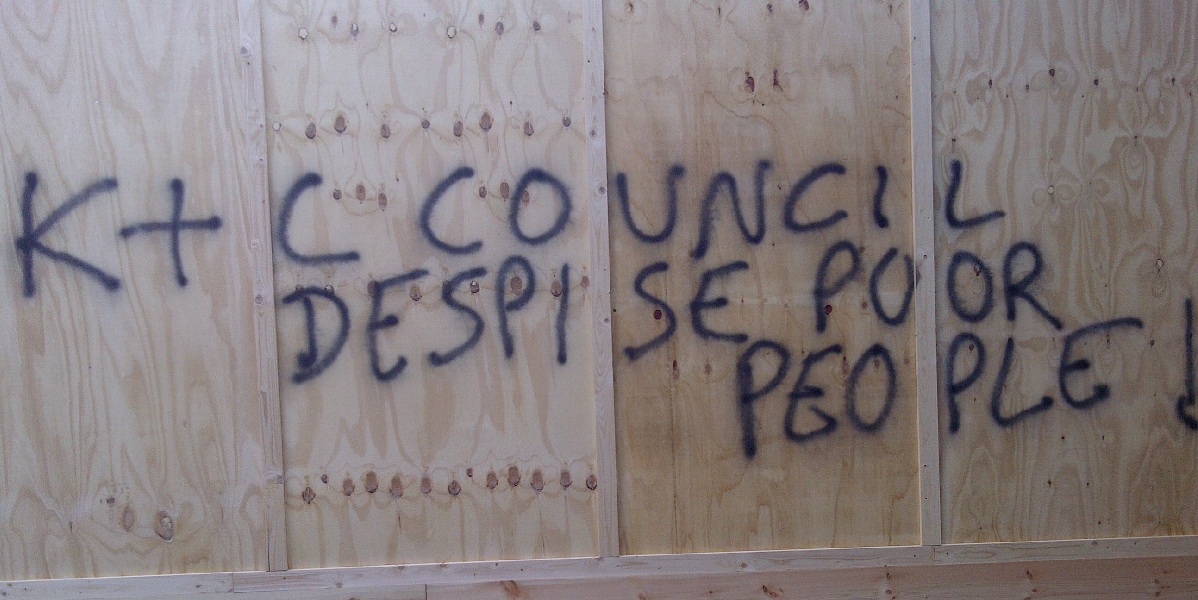
Cover Image: photo by TC, graffiti at the foot of Grenfell Tower, 2013



Leave a Reply