
Here’s an update on the North Kensington community asset Canalside House. At the top of Ladbroke Grove, neglected, unprotected and heading for sale to Ballymore then demolition unless people act soon on the information below…
See our July update here.
Campaign
Summer saw the grassroots campaign, Save Canalside House, move into action, alongside the wider Stop Project Flourish endeavour. Campaigners worked a stall on Fridays on Portobello and Golborne, and a petition steadily gained signatures.
One of the campaigners penned this excellent article, providing some essential historical perspective on the Kensal Gasworks area. And another campaigner has been diving deep into the history, digging up the facts on Canalside House, which we hope to publish here soon.
Landlord
While campaigners campaigned, the residents of Canalside House – mainly charities, and all from Black and minority ethnic Diaspora communities – continued to suffer under the neglectful watch of their landlord, Kensington & Chelsea Council (RBKC). Like the residents of Grenfell Tower, these organisations are being ignored by RBKC. The council didn’t invoice the tenants for their rent payments in May and June; RBKC provided no explanation for this, leaving open the possibility that they were trying to engineer a situation in which they could accuse tenants of non-payment to support the case for eviction.
While the established pattern is that RBKC ignores the resident organisations, there is an exception: we were told that the council offered one Canalside charity a new office nearby, but with a 300% increase in rent.
There was a visit to Canalside from RBKC’s Strategic Head of Property, David Allen, earlier this year. We were told by several residents that, during their meeting with Allen, the council officer, who “comes from a Private Equity Real Estate background,” informed them he had “told Ballymore not to speak to tenants”.

Allen’s anti-democratic approach typified the controlling style of the council with regard to Canalside, most notably from Deputy Leader Kim Taylor-Smith who made false promises about investing in the building and the communities that use it. Some campaigners have drawn parallels with the way the Westway was imposed on North Kensington, with the disproportionate impact on BME groups. Ballymore’s dubious track record in London has added to the sense of a stitch-up, as has the developer’s reliance on architectural consultancy Turley to downplay the importance of Canalside House.
Corruption?
Rock Feilding-Mellen, erstwhile RBKC Deputy Leader-turned fugitive-turned purveyor of psychedelics, had Canalside House firmly in his sights before the Grenfell Tower fire scuppered his political career (Mellen uses his access to national media outlets to claim personal victimhood) and, despite his successors promising change (ad nauseam) for eight years, they have proved themselves to simply be his successors.
A brief review of the council’s official policies tells us there is still every reason that Canalside House could and should be saved; it is just a matter of RBKC being a bit democratic, a bit consistent and following through on their own decisions.
Asset Strategy
RBKC’s 2025-2030 Interim Asset Strategy is filled with arguments in favour of preserving Canalside House. I’ll go through them, but this is just one of a litany of other laws, policies and promises that the council are supposed to adhere to.
According to the Asset Strategy, the purpose of RBKC owning property is to provide “the best value and community benefit” – neither of which have been mentioned by the council in its rare utterances on the Canalside deal. Taylor-Smith did claim that the deal was contingent on Ballymore agreeing to “reprovision community space” but this appears to have been another falsehood from the Deputy Leader.
The Asset Strategy asserts that RBKC is “putting…transparency at the heart if our asset planning” – but council struck a secret deal to sell Canalside House over two and a half years ago and has yet to meaningfully engage with anybody in the community about it. There is a vast gulf between rhetoric and reality.
The Asset Strategy goes on….“the Council’s work is underpinned at all times by the understanding that its assets are held on behalf of, and for the benefit of, the community” yet the process at Canalside has been designed to preclude discussion and scrutiny.
The Strategy document explains that 43 third sector organisations use council-owned properties. The demolition of Canalside House would reduce this to under 30, if the organisations aren’t given replacement offices. The document states that the 43 charities have leases and licenses that range in length “from periods of three to 50 years” which is news to the Canalside residents, who are always left to wait months for their annual renewals.
“The council should consider disposal of property in circumstances where it is uneconomic to retain it and where there is no credible financial, service or community case to retain.” Even if there is a financial case, which RBKC might argue (post-omertá) is the case with Canalside, the Asset Strategy is explicit that “engagements must precede decision making processes” which has not happened in this case. Engagement before decision-making processes is also required under the council’s own Charter for Public Participation.
The Asset Review acknowledges the centrality of the Local Government Act 1972 (section 123) which requires RBKC by law to secure “best consideration” for residents. But on Canalside, the council has assumed it knows what is best for the residents in the north of the borough. None of the decision makers at RBKC were elected by North Kensington residents, who are represented by a mix of Labour, Green and independent councillors.
Selling a public asset to a private interest in a secret deal is prohibited under the Asset Strategy: “The disposal route should be by default a market sale” and “should follow One Public Estate fairness principles.”
And That’s Just One Document
There are plenty more policies and laws that favour the non-sale of Canalside House. Here’s a non-exhaustive list:
- 2023-2027 Council Plan: “has the ambition for the borough to become fairer for all residents” with the “key themes” being “greener, safer, fairer and caring & competent” – where does the secret deal to sell a scarce public resource to an international property developer so they can demolish fits with the four priorities?
- The Council Plan commits to securing assets for the most deprived areas of the borough: “Council and community infrastructure should be located in the areas of the Borough where the need is greatest, in the four most deprived wards, Golborne, Notting Dale, Dalgarno and Chelsea Riverside” – Canalside House is in Dalgarno ward and borders Golborne.
- RBKC Asset Review 2018: The findings of this review remain unpublished despite the public paying for government officers to lead the work. We know that the Review identified “four contentious assets” but we don’t know what these were and RBKC has not responded to our questions about it.
- RBKC North Assets 2018: Lists Canalside House as an “established 3rd sector office location – no longer planned to be sold.”
- Lessons from Grenfell Tower are supposed to inform everything this council does to “ensure that the tragedy is never forgotten” according to the Asset Strategy, yet Canalside House shows that this is simply not happening, and the same deadly attitude towards our communities persists.
- Grenfell Scrutiny Committee: This was scrapped in 2019, depriving opposition councillors of the ability to hold RBKC leaders to account over whether or not they are honouring those lost.
- Equality Act 2010: Completely disregarded in the case of Canalside. The council even turned down a grant from Tudor Trust that would have fully funded a lift in the building. Because of this never-explained decision, accessibility into one of North Kensington’s key hubs for disabled people is difficult and, in many cases, impossible.
- Equality Impact Assessment: With RBKC ignoring the protected characteristics of the Canalside House residents, Leader of the Labour Group, Councillor Kasim Ali vowed to take the issue of racial discrimination to the council’s CEO, senior officers and political leaders. We understand that Cllr Ali – who at the time of writing is busy fostering ties between Britain and Azerbaijan – has not raised this issue with the RBKC hierarchy, giving them a free pass to enjoy Black History Month without the interference of any nagging reality checks.
- RBKC Equalities Policy: States that resident voice comes first when it comes to assets. At the risk of stating the obvious (to our loyal readers) and to make it clear (to the council’s press office and policy makers) RBKC has minimised resident voice and perpetuated a situation in which policy is done to communities.
- RBKC New Local Plan: States that the council’s Charter for Public Participation should be used in situations such as Canalside House. Click here for a breakdown of their comprehensive failure over this publicly-funded policy.
- The Charter for Public Participation: In theory, application of the principles set out in the Charter would stop the Canalside deal dead in its tracks. RBKC is “renewing” its Charter, although that is a misnomer as they failed to implement it the first time around.
- The Investment Fund for Council Properties: Is supposed to work with a resident panel but doesn’t, hence no resident interference in the Ballymore deal.
- “Social Value”: RBKC has arbitrarily bestowed benevolence on some charities, including one benefiting from two years of free rent, while disregarding Canalside residents’ proven social value entirely.
- RBKC Putting Communities First: “A specialist resource to support council departments and services to consult, listen, engage and partner with communities so everyone’s voice is heard.” A question to this ‘Specialist Resource’: has anybody in North Kensington asked for a property developer to demolish a community building and replace it with a “green space” next to the permanently traffic jammed roundabout on Ladbroke Grove?
- Local Government Act 1979: RBKC supposedly operates within the confines of this Act of Parliament, which enables local authorities to sell public assets, but balances that power by dictating that sale must be the “best possible consideration” for residents – if RBKC was acting in accordance with this legislation, would it have done a secret deal to sell the building to Ballymore? Would it have insisted to Ballymore that the whole deal hinged on them buying Canalside House? Would it have ignored all our questions on these matters?
- Project Flourish: Canalside House does not feature in the original plans as it sat outside the boundaries of the proposed development. The development was adjusted to swallow up the building. Ballymore’s claims that in phase two of their building work, they will complete the “relocation of Canalside House back into a new Grade A office…of higher quality than existing” are not believable. In meetings with campaigners and residents, Ballymore showed some interest in supporting the Canalside groups but complained about RBKC’s lack of engagement on the subject.
- Residents Associations Open Letter to RBKC: The letter sets out alleged procedural, safeguarding and date protection failings by Ballymore and fellow-developer Sainsburys. Click here to read.
- Historic England: Responding to a community application to designate Canalside House as an Asset of Community Value, Historic England stated that the building has “group value with other unlisted buildings relating to the gasworks site and with two nearby listed buildings” and that it would “make a positive contribution to the conservation area were one to be designated…the association with the Kensal Gasworks…carries some historic interest, this is of local rather than national interest.”
Cityscape
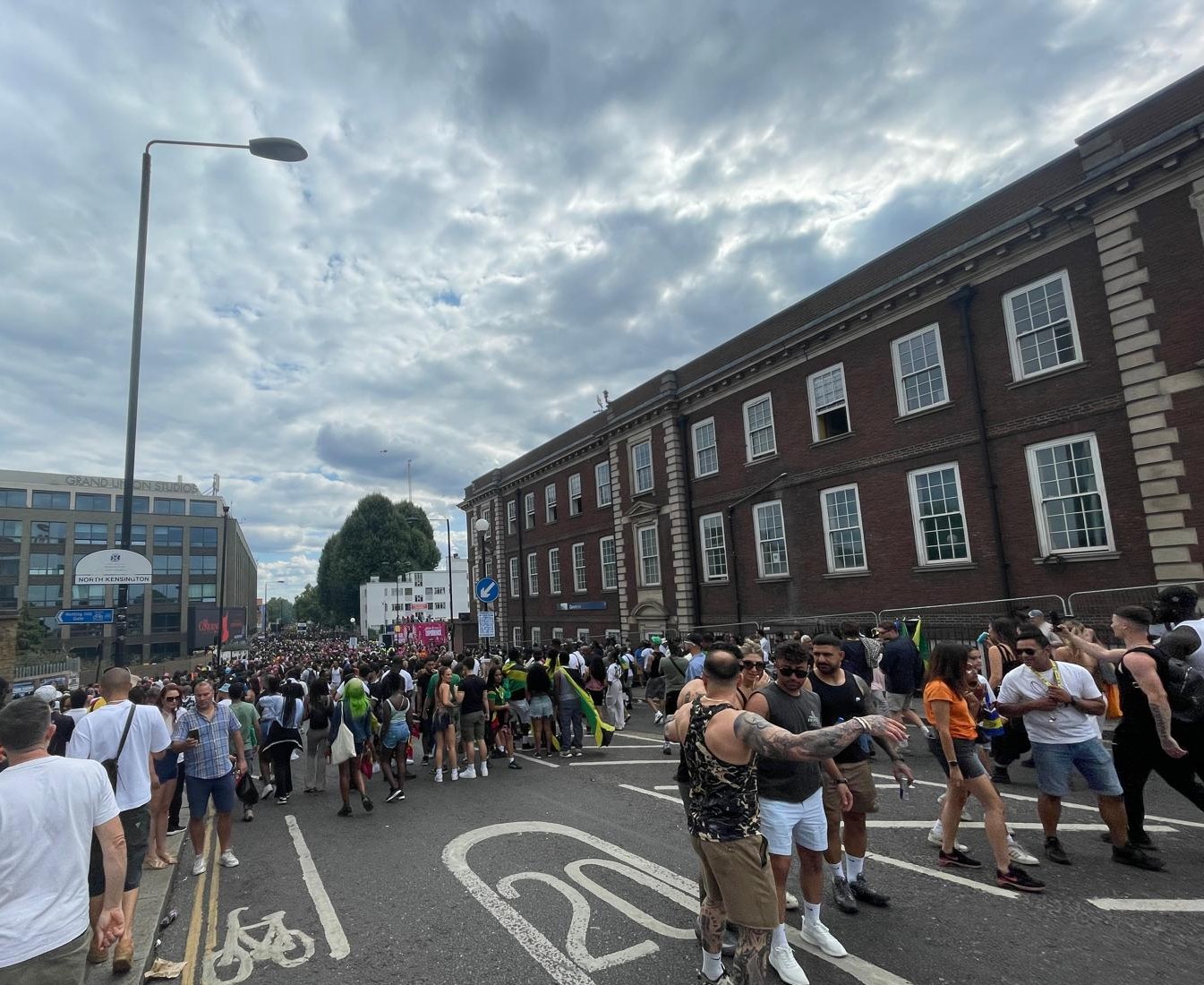
Canalside House had a good Carnival; a backdrop for art, music, culture and life….


Elton John is a fan, using the building as the Cold War backdrop for his 1985 hit Nikita…

Built in 1929, Canalside House predates and outlived the Cold War. Can the iconic building outlive the gentrification of Ladbroke Grove and preserve a scare community resource? Ballymore’s application is scheduled to be heard by the RBKC Planning Committee on November 11th.
by Tom Charles @urbandandyldn @tomhcharles



 Urban Dandy
Leave a comment