A report on Kensington & Chelsea Council’s final community meeting before they present their response to the Grenfell Tower Inquiry Phase 2 Report.
On Thursday 7th November at Maxilla Social Club, former Bishop of Liverpool James Jones spoke an undeniable truth, that for those impacted by the Grenfell Tower fire, re-engaging with the local council’s community consultations is “re-traumatising.” For many in attendance, it was a familiar feeling after nearly seven and a half years of painful participation, unable to move on from the horrors of Grenfell and denied the power to create tangible change anywhere near commensurate with the scale of the crime. Outside, the deformed Grenfell Tower stood shrouded, cold and still. Inside the working men’s club, the central heating was maxed and a cross-section of Kensington people engaged in much mental activity, games within games. The evening would end in stalemate…
Opening Moves
Changing the format from their previous two community meetings, Kensington & Chelsea Council (RBKC) set up the room with their officers and politicians spread across eight or so tables. RBKC distributed print-outs listing their key themes for discussion, a strategy to contain the debate within their parameters and to support their goal of producing an official response to the Grenfell Inquiry Report. The community had some print-outs of its own, titled ‘Council Leader Elizabeth Campbell – selected quotes 2017-2014’ and ‘Save Canalside House – Community Campaign Position Paper’.
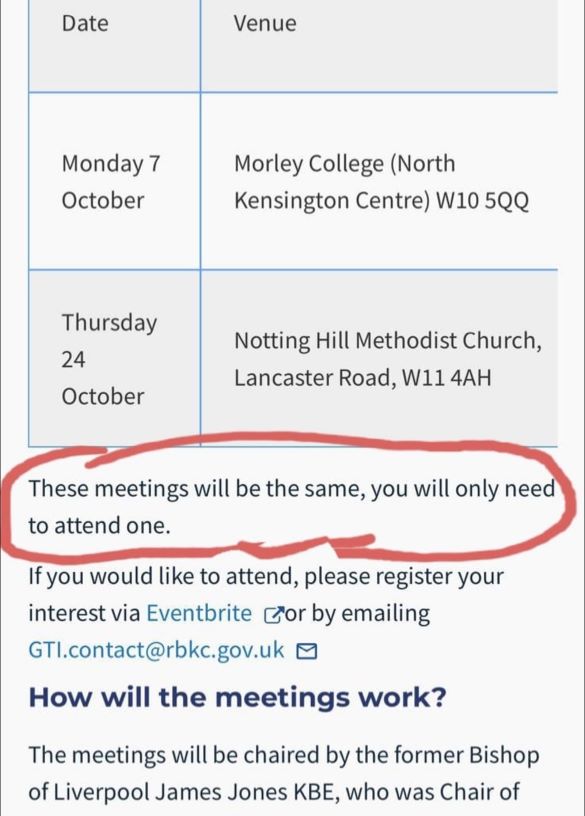
Bishop Jones hosted, invoking his experience after the Hillsborough atrocity and asking us to stand for 72 seconds of silence. It’s a strange experience, standing with council leaders, and not one any interlocuter should presume we are comfortable with. RBKC Leader Elizabeth Campbell and CEO Maxine Holdsworth say a few words – functional and minimal.
Views
At the tables, groups were asked to consider RBKC’s themes and provide feedback on nine areas of potential change in how the council conducts the business of local government. Council officers wrote down all they heard, and after 15 minutes, one person from each table presented the views of their group to the room:
‘Why is Councillor Lindsay the only one to resign?’
‘We need an action tracker, so when you say you’ll do something, there’s a way of checking that you do it.’
‘There need to be mechanisms for accountability. At the moment you’re not accountable to anybody.’
‘There have been failures in meeting statutory duties.’
‘There have been cuts to the Building Control budget but there’s always money for Opera Holland Park.’*
‘At the last meeting, we had Councillor Campbell’s epiphany. It took her seven and a half years to realise that people want decent services and to be treated well.’
‘This is exhausting – you are paid for this, we aren’t.’
Strategy
Throughout Autumn, RBKC has employed a two-pronged strategy which it hopes will see it safely through the post-Grenfell Inquiry period: Mea culpas aligned with the Inquiry Report’s criticisms, and careful public relations management of the narrative.
At Maxilla, Cllr Campbell again emphasised some of her council’s epic failures:
“Cultural indifference.”
“We didn’t listen.”
“Political incompetence and political disregard.”
“Lack of transparency.”
Cllr Campbell was referring to the years before the fire, but she could just as easily have been talking about 2024, a point emphasised by a contribution to the meeting from the Deputy Director of a charity based at Canalside House:
“How will the council ensure transparent and consistent communication with Canalside House tenants, especially considering that many service users were impacted by Grenfell and that Canalside House served as a crucial relief area during that time?”
Those who use Canalside House have been earnestly trying for years to speak with RBKC Deputy Leader Kim Taylor-Smith and council officers about plans to demolish the building, one of North Kensington’s last remaining community assets. They have been met with indifference; not listened to; disregarded and provided with zero transparency, all while having to listen to RBKC’s claims to have “changed.”
Canalside House was raised three times at Maxilla, but RBKC continues to neglect the issue. Will it feature when the council’s leadership presents its response to the Inquiry Report tonight?
Next to Canalside House is the Kensal Gas Works site, earmarked for development into a new ‘neighbourhood’ by international property developers. CEO Holdsworth told Maxilla that Project Flourish will contribute to solving the housing crisis. Numerous people immediately pointed out that Flourish offers just 12% social housing.
Undeniable Truth
Cllr Campbell voiced an undeniable truth: “It’s about the power imbalance and acknowledging that.”
It was another moment of clarity from the council Leader. In a room where highly-paid RBKC officers and property developers mixed with traumatised working class residents, extreme cognitive dissonance was required to believe that this local authority was there to find ways to meaningfully alter the power balance.
RBKC’ put ‘change’ policies in place shortly after the fire – the Hillsborough Charter; the Charter for Public Participation; and now the main modifications to the New Local Plan the government has instructed them to make. The problem remains that the principles set out in these documents are at odds with the political aims of Kensington & Chelsea Council.
This is where the second part of their strategy, public relations, comes into play. As we reported in September, the council’s way of handling the damning verdict of the Grenfell Inquiry Report is spin and managing the narrative.
At Maxilla, the council’s literature included the 7.5 year-old phrase “rebuilding trust” – the recent appointment of a Managing Partner of Chayton Capital (a private equity real estate fund business) as RBKC’s Strategic Head of Property will add to the doubts about the sincerity of the phrase. Will a vulture capitalist look after the interests of the young people for whom Canalside House is an educational and social lifeline? Or will he be a vulture capitalist?
Questions like these were not among RBKC’s key themes at Maxilla. Bishop Jones made criticisms of the council, but they were based on the past, in line with the Inquiry Report and were non-specific. Cllr Campbell’s mea culpas and her promises of change were equally vague.
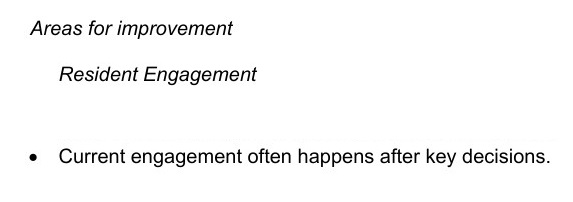
RBKC’s response to be presented at the Town Hall tonight – under the subheading “Areas for improvement – Resident engagement” – confirms that the council often consults residents only after decisions have already been made.
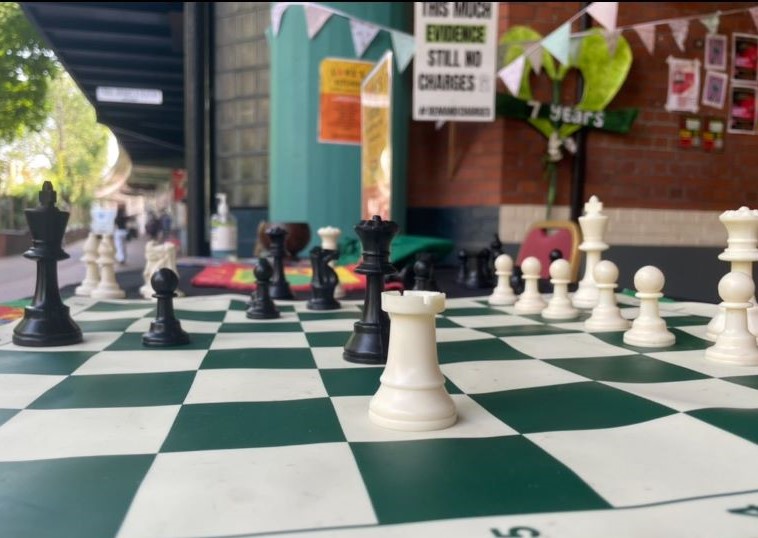
This was the game within the game at Maxilla. A generous reading of the evening was that some RBKC staff seemed well-meaning; some of the officers accept the parameters within which they are permitted to pursue change and they work enthusiastically in that narrow space; but there can be no generous view taken of the senior councillors who were in leadership positions before the fire – including Cllr Campbell – or those who have thwarted change ever since, most significantly Cllr Taylor-Smith, who was at Maxilla but not among the speakers.
The public relations spin continued throughout the Maxilla meeting and will dominate the council’s official response to the atrocity, currently viewable in draft format: Public reports pack 13112024 1830 Leadership Team
In their official response to the Grenfell Inquiry, they will claim improvements to “understanding our communities.”
They will say they have a “more in-depth understanding of residents’ needs (including diverse communities)”
They will cite “work on inequality and deprivation through the Fairer Action Plan”**
They will make the claim that “Lead members are now more visible and accessible to residents”
They will say they are now “listening to residents” and cite their Charter for Public Participation.
They will refer to a Citizens’ Panel and they will declare the “establishment of a consultation gateway to ensure proposals for consultation are routinely tested against the commitment in the Charter for Public Participation.”
Most of it is nonsense, the local government equivalent of “What can be, unburdened, by what has been.”
Final Moves
One week before this meeting I was in Valencia when flash floods killed hundreds of residents. Valencians told me the local government had failed the people via budget cuts and disregard. It would have been absurd if I had responded, “Don’t worry, in seven years’ time you’ll have the same leadership, and they’ll have a Citizens’ Panel and a Charter for Public Participation.”
I wrote a note to my neighbour at the table at Maxilla:
“This is just a focus group for them to make a list of things they are going to pretend to do.”
She replied: “WITH THE SAME PEOPLE WHO SCREWED UP BEFORE.”
As the Bishop began his final remarks, a local resident wanted raise an issue; the Bishop and council leaders tried to cut her off, but a councillor insisted and the resident asked: “With the amount you spend on communications, why isn’t this meeting being filmed so more people can participate? There are 50 residents here but about 50,000 people live in North Kensington.”
There was no explanation.

At 8pm the Bishop called time; stalemate – no change. RBKC edged closer to publishing their response to the Inquiry Report. The community earnestly engaged yet again but knew their opponent protected the power imbalance. An important passage from the Grenfell Inquiry Report explains why that dynamic remains so unjust and counter-productive:
“Those to emerge from the events with the greatest credit, and whose contribution only emphasised the inadequacies of the official response, are the members of the local community.”
by Tom Charles
@UrbanDandyLDN
@tomhcharles
*RBKC sought to blame Building Control for numerous failures, despite halving its budget over five years. Simultaneously RBKC underwrote Opera Holland Park’s losses of £5.8 million
**Golborne ward in North Kensington is the most deprived ward in London, with its poverty worsening since the Grenfell fire. Notting Dale, which includes Grenfell Tower, has also become significantly more impoverished, joining the top 10 in London’s Index of Multiple Deprivation since 2017.
 Urban Dandy
Leave a comment