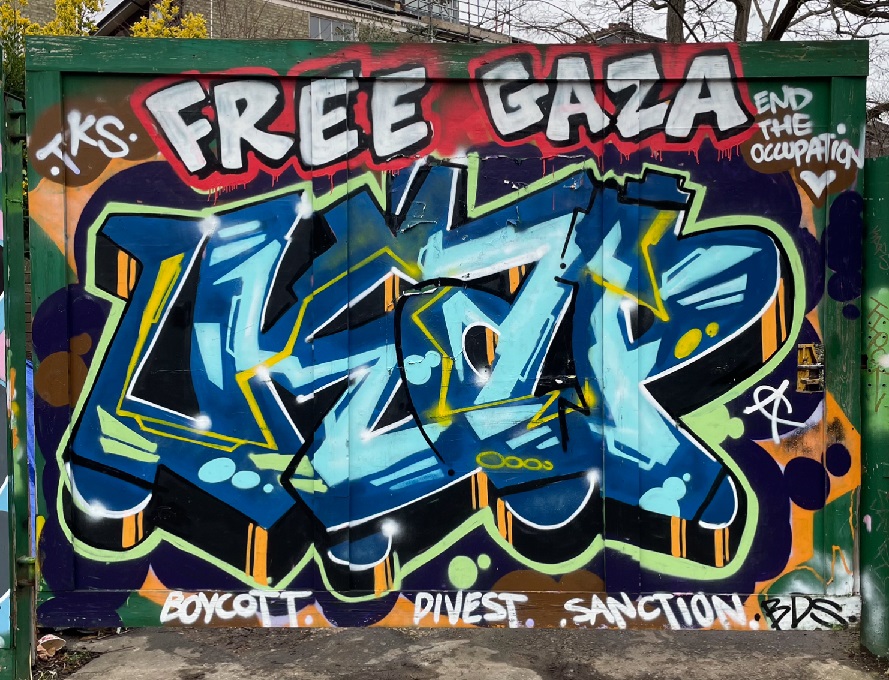
A motion calling on Kensington & Chelsea Council (RBKC) to divest from Israel’s war machine and endorse a permanent ceasefire in the Gaza Strip was thwarted at the Town Hall last week, with both the Conservative majority and opposition Labour groups refusing to back the move. Tory-Labour support for Israel in Kensington reflects the national picture with Zionists dominating discourse and policy-making.
Divestment
The call for divestment from Israel is part of a global movement called Boycott, Divestment & Sanctions (BDS) that seeks through non-violent methods to end international support for Israel’s crimes and to push for international law to be implemented. The premise of BDS is simply that Palestinians are equal to other human beings and entitled to the same rights.
Since 1947 Palestinians have suffered dispossession, dislocation, and immiseration at the hands of Israeli colonisers, enabled by the western powers. Despite toiling under decades of military occupation, Palestinian civil society was inspired by the South African anti-Apartheid struggle to launch BDS in 2005, calling on the world to use non-violent means to help secure three specific victories: Ending Israel’s illegal occupations, including removal of the apartheid wall; recognition of the right of Palestinians inside Israel to equal citizenship, and the fulfilment of Palestinians’ right of return to their land, as enshrined under UN General Assembly Resolution 194.
Divestment in the West
Ronald Storrs, a British governor of Jerusalem from 1917-1926 stated that the purpose of establishing a Zionist colony in the Middle East was “forming for England ‘a little loyal Jewish Ulster’ in a sea of potentially hostile Arabism.” As Israel is a western colonial implant in the Middle East, the views and actions of western publics towards the project are significant. Without western military, political and economic support, Israel would not be able to usurp the Palestinians, Lebanese and Syrians, nor be able to look to establishing ‘Greater Israel’ from the Nile to the Euphrates.
Divestment is important as a tool for western campaigners for two reasons. One is the precedent of success against the white supremacist system in South Africa. The second is that, on their own, Palestinians in Palestine cannot practise non-violent rebellion in a way that turns the tide of history away from injustice and to the rule of international law. The clearest proof of this was the 2018 Great March of Return when Palestinians marched unarmed to the Gaza-Israel border displaying their commitment to their right to return to their original homes. Israel responded by shooting into the crowds, killing hundreds, and injuring tens of thousands, mainly women and children.
In this context, every struggle waged for justice at every western company, university, media outlet or local authority matters as it is through these small wins that the Palestinians and their supporters can accumulate enough momentum and credibility to take on the Zionist movement.
Zionism – the belief that an exclusivist Jewish state should exist in place of Palestine – is not an ideology with much relevance to the daily lives of most British people. In a political system responsive to the needs and wishes of 70 million citizens, Zionist demands would not be prominent on the agendas of our public servants. It has therefore been necessary for the Zionist movement to develop systems of extreme pressure that can be applied on politicians, taking advantage of their cowardice, fear, cognitive dissonance and colonial (aka racist) western mindsets to secure support Israel in a variety of ways, from full-throated zealotry to acquiescence. The result is that the entire British establishment, with a few notable exceptions, moves in support of the Zionist project. This extraordinary level of support for Zionism among Britain’s elites requires their acceptance of the premise that Jewish Israeli lives are inherently more valuable than Palestinian lives. It also follows that those advocating Zionism, actively or passively, will resist any attempts to delegitimise Israel and its policies.
RBKC
In December 2023, at a Full Council meeting, independent councillor Dr Mona Ahmed invited RBKC Leader Elizabeth Campbell to condemn Israel’s atrocities, call for a ceasefire and make public space available for vigils, as she had when Russia invaded Ukraine in 2022. Campbell declined. The council leader’s attitude towards Israel/Palestine was inconsistent with the borough having the second largest Arab community in London, but it was consistent with the council’s reflexive loyalty to Israel and disregard for affected residents.
Last week, Cllr Ahmed again invited a Full Council meeting to take a stand against Israel’s crimes, with a motion calling for divestment and ceasefire. The Conservatives were resolute in their support for Israel, and the Labour Group abstained. Cllr Ahmed responded that it is “the silence of friends and not the words of your enemies that can be the most alarming.”
The Zionist lobby can count on both in Kensington. More on the full council meeting coming soon….
@tomhcharles



 Urban Dandy
Leave a comment